
Blood Flow and Erections: The Mechanics Explained
Rigidity is not produced by muscle contraction. It is produced by pressure — and pressure requires blood to arrive faster than it leaves.
The most useful thing to understand about erections is that the penis contains no bone and no contracting muscle that produces stiffness. What it contains are two parallel cylinders of sponge-like tissue running along the top, called the corpora cavernosa, and a smaller one underneath surrounding the urethra. Rigidity comes from filling those cylinders with blood at pressure and then trapping it there. Everything that goes right or wrong with an erection is a variation on that single mechanism.
Step one: the signal
Arousal — whether it originates in the brain or from direct physical contact — travels down nerves that terminate in the penile tissue. Those nerve endings, along with the endothelial cells lining the arteries, release nitric oxide. Nitric oxide is a gas, it diffuses across cell membranes in milliseconds, and it exists in the body for only a few seconds before breaking down. It is a signal, not a substance that accumulates.
This is the step that no medication replaces. If the nitric oxide signal never fires, nothing downstream happens, which is precisely why PDE5 inhibitors do nothing without arousal. Men who expect a tablet to work while they are distracted, disinterested or asleep are surprised when it does not, and the reason is here at step one.
Step two: the amplifier
Nitric oxide activates an enzyme called guanylate cyclase inside the smooth muscle cells of the penile arteries. That enzyme converts GTP into cyclic GMP. Cyclic GMP is the actual working molecule: it lowers calcium inside the smooth muscle cell, and low calcium means the muscle relaxes. Relaxed arterial muscle means a wider artery.
At rest, the arteries feeding the corpora are held deliberately narrow. The flaccid state is not passive — it is actively maintained constriction. When cyclic GMP rises, that constriction releases and arterial inflow can increase many times over within seconds.
Step three: the trap
Blood floods into the sinusoidal spaces of the corpora, which expand like a sponge taking on water. Around each corpus is the tunica albuginea, a dense fibrous sheath with very little give. As the sponge expands against that inelastic sheath, internal pressure climbs steeply.
The small veins that drain the corpora run between the sponge and the sheath. Rising internal pressure compresses them flat against the tunica. This is the veno-occlusive mechanism, and it is the reason an erection is firm rather than merely engorged. Inflow alone produces swelling; trapped outflow produces rigidity. During a full erection, pressure inside the corpora approaches systolic blood pressure.
Step four: the off switch
An enzyme called phosphodiesterase type 5, or PDE5, is constantly present in penile tissue, and its job is to break cyclic GMP down into ordinary GMP. Once the arousal signal stops, no new cyclic GMP is being made, PDE5 clears what remains, calcium returns to the smooth muscle, the arteries constrict, pressure falls, the veins reopen, and blood drains away.
Cyclic GMP is therefore always being produced and always being destroyed at the same time. An erection is not a switch position — it is a balance between two competing rates.
Where things go wrong
Weak inflow. If the arteries are narrowed by atherosclerosis, or if the endothelium produces less nitric oxide because of diabetes, hypertension, high cholesterol or smoking, cyclic GMP never rises high enough. The result is difficulty getting hard at all, or getting only partially hard.
Failure of the trap. If the tunica or the surrounding tissue has lost elasticity, the veins are not fully compressed. Blood enters normally and then leaks. The result is getting hard and then losing it, often within a few minutes, and often worse when standing or changing position. This is called venous leak.
Sympathetic override. Adrenaline is a potent constrictor of the same arteries. Anxiety, stress, cold or pain can hold the arteries closed regardless of how much arousal is present. This is the mechanism behind performance anxiety, and it explains why the problem is genuinely physical even when its trigger is psychological.
Nerve damage. Prostate surgery, spinal injury and long-standing diabetic neuropathy can interrupt the signal before it arrives. PDE5 inhibitors depend on that signal, so their effectiveness in these cases varies considerably.
What a PDE5 inhibitor actually does
It occupies the active site on the PDE5 enzyme so the enzyme cannot break down cyclic GMP as quickly. Nothing else changes. Production stays exactly where your own arousal put it; destruction slows down. The balance shifts, cyclic GMP accumulates to a higher level for a given amount of arousal, the arteries open wider, pressure builds further, and the venous seal engages more completely.
Read that sequence again and three practical consequences follow. It cannot work without arousal, because you cannot preserve a molecule that was never made. It does not force an erection to persist indefinitely, because when arousal stops, production stops and clearance eventually wins. And it does not increase desire, because desire is generated in the brain, several steps upstream of anything happening in the tissue.
Why sildenafil and tadalafil behave differently
Both bind the same enzyme; they differ in how long they stay bound and how fast they get there. Sildenafil peaks quickly and clears in a matter of hours. Tadalafil takes longer to reach peak concentration but has a half-life measured in tens of hours, which is why it is sometimes described as covering a weekend rather than an evening.
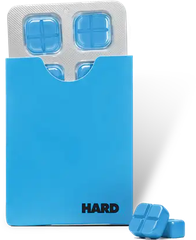
HardRx puts both into a single sublingual tablet. Dissolving under the tongue lets a portion of the dose enter through the mucosal blood vessels directly rather than waiting on the stomach, which is why food is less of a factor than with a swallowed tablet. The design intent is a shorter runway from the sildenafil and a longer tail from the tadalafil. The ingredients page covers this in more detail.
The one-sentence version
Arousal makes cyclic GMP, cyclic GMP opens the arteries, open arteries build pressure, pressure seals the veins, and PDE5 clears cyclic GMP to end it — so a PDE5 inhibitor simply tilts an existing balance in your favour without replacing any step you have to bring yourself.
Common Questions
Because the tablet slows the breakdown of cyclic GMP rather than producing it. Arousal is what produces it. With no arousal there is nothing to preserve, so nothing happens.
It describes an erection that starts normally but cannot be held, because the veins draining the erectile tissue are not fully compressed. Blood enters and then escapes. It presents as losing firmness within minutes rather than struggling to get hard.
Yes, temporarily. Cold triggers sympathetic vasoconstriction throughout the body, and the small penile arteries respond like any other. It is a normal physiological response, not a sign of dysfunction.
Frequently. Endothelial function responds to aerobic exercise, blood pressure control, blood sugar control and stopping smoking, and the penile arteries are small enough to register that improvement early.
Ready when you are
A five-minute assessment, a licensed physician, and free discreet delivery.
Safety & Important Information
Take only the dose you were prescribed, and never more than one in any 24-hour period. HardRx is not suitable if you take nitrates or have certain heart conditions. Side effects are usually mild and may include headache, flushing, dizziness or nasal congestion. Nothing on this page replaces professional medical advice — read the full safety information before ordering.
Take Control Today With HardRx
More performance. More confidence. A better you.